Agent Enablement OS: Training Teams to Work with AI Copilots
Agent Enablement OS: Training Teams to Work with AI Copilots
Most agent deployments fail quietly-not because the models are bad, but because humans never learn how to collaborate with them. Sellers ignore agent drafts, analysts distrust insights, and managers have no metrics proving adoption. The fix is an enablement operating system that treats agents like new teammates: onboard them, train people to co-work with them, capture feedback, and reward the right behaviors.
Thesis: Automation succeeds when enablement and change management move in lockstep with engineering.
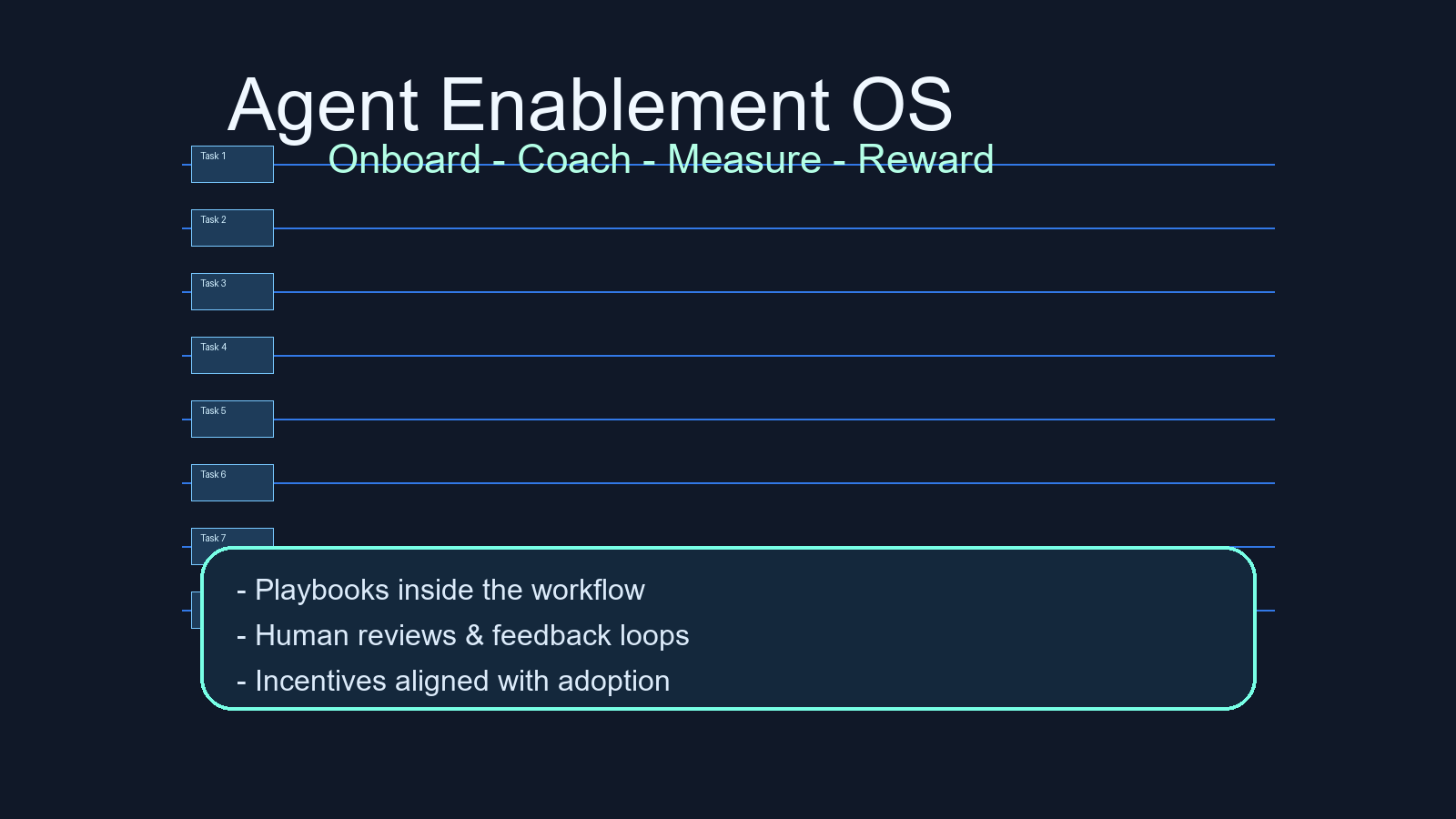
We will cover five pillars: onboarding, playbooks, coaching, incentives, and measurement.
Pillar 1: Agent and Human Onboarding
Treat agents like employees. Draft a "role card" describing scope, strengths, limitations, and escalation paths. For humans, build learning paths inside your LMS (WorkRamp, Lessonly) that include video walkthroughs, hands-on labs, and knowledge checks that certify readiness. Pair each workflow launch with a short synchronous training (office hours or live demo) so teams can ask questions before hitting production.
Publish an "Agent FAQ" on the intranet so employees know where data comes from, how to report issues, and who maintains the system. Add a "What the agent cannot do" section to set expectations; clarity prevents misuse and builds trust.
Pillar 2: Playbooks and Work Instructions
Codify tasks in living playbooks. Template:
- Mission name + business outcome.
- Inputs (systems, data fields).
- Agent steps (prompts, tools) with screenshots.
- Human checkpoints (approve, edit, escalate).
- Metrics (SLA, accuracy).
Store playbooks in Notion or Confluence and link them directly inside the agent UI (tooltip or help button). Update them whenever prompts or tools change so frontline users are not stuck with stale instructions. Encourage teams to fork and improve playbooks under change control — you want a library that evolves alongside the product.
Pillar 3: Coaching and Feedback Loops
Managers should review agent usage during weekly 1:1s. Provide heatmaps showing adoption rate (% tasks initiated via agent), edit rate (% of outputs rewritten), and top escalation categories. Use this telemetry to tailor coaching: high edit rate indicates prompt tweaks or additional training; low adoption suggests workflow friction.
Create a simple feedback conduit (Slack channel, in-product thumbs up/down) routed to the AI platform team. Close the loop by responding publicly to feedback ("Prompt updated, regression fixed"). This reinforces that human input matters and keeps adoption from stalling.
Pillar 4: Incentives and Recognition
Align incentives with desired behavior. Examples:
- Add "agent collaboration" goals to performance reviews (e.g., keep edit rate below 30% while maintaining NPS).
- Reward teams that contribute new playbooks or edge-case reports.
- Highlight success stories in all-hands meetings ("Agent caught in at-risk revenue").
Avoid punitive adoption mandates. Instead, show how the agent frees time for higher-value work and offer career paths like "Agent Specialist" for people who excel at co-developing workflows. Tie spot bonuses or hack-day prizes to agent improvements; culture follows compensation.
Pillar 5: Measurement and Continuous Improvement
Instrument adoption dashboards (Looker, Mode) with KPIs such as time saved per workflow, accuracy before/after agent intervention, human satisfaction (pulse surveys), and escalation response time. Segment metrics by team or geography to spot outliers.
Run quarterly retros with AI engineering, enablement, and business leaders. Review KPIs, playbook updates, and backlog of enhancement requests. Treat agent enablement as a continuous program, not a launch event; allocate headcount the same way you would for sales enablement or DevRel.
Conclusion
Agents do not magically slot into human workflows. Building an enablement OS ensures people know when to lean on automation, how to improve it, and why adoption matters. Combine onboarding, playbooks, coaching, incentives, and measurement to turn AI from a science project into a trusted teammate.
Next read: "Humans in the Loop: Why Agents Handle Tasks, Not Whole Roles."
Open question: Could adaptive training systems personalize agent coaching per user based on telemetry, similar to sales enablement platforms? Whoever cracks that will close the loop between AI and human learning.
Related Tools
Useful tools for this topic
If you want to turn this article into a concrete next step, start with one of these.
Solution Type Quiz
PlanningDecide whether your use case is better served by automation, a chatbot, RAG, a copilot, or a more capable agent.
Open toolReadiness Scorecard
PlanningAssess whether the workflow, data, access, and risk controls are mature enough for a real pilot.
Open toolBuild Path
PlanningGet a practical recommendation for how to start based on team size, skill, urgency, and compliance pressure.
Open toolSubscribe to AgentForge Hub
Get weekly insights, tutorials, and the latest AI agent developments delivered to your inbox.
No spam, ever. Unsubscribe at any time.