
Knowledge Freshness for AI Agents: How to Keep Retrieval from Going Stale
Knowledge Freshness for AI Agents: How to Keep Retrieval from Going Stale
An agent that cites last quarter's pricing, a retired policy, or a stale support article is not "almost right." It is expensive. In 2026, that is one of the biggest operational lessons teams are learning the hard way: retrieval quality is not just about relevance. It is about freshness.
This guide is a practical playbook for agents that depend on changing information. The goal is simple: help your agent know when to trust a source, when to refresh it, and when to admit it might be out of date.
TL;DR
Treat freshness like a first-class ranking signal. Give every source an update cadence, expiration rule, and owner. Prefer recent authoritative content over merely similar content, and make the agent visible enough to say, "This may be stale, here is what I checked."
The hidden problem is not retrieval, it is decay
Most teams obsess over chunking, embeddings, and rerankers. Those matter, but a beautifully retrieved wrong answer is still wrong. Internal documentation decays quietly. Vendor policies change on a Tuesday. Product screenshots become archaeological artifacts by Friday afternoon.
That is why stale knowledge is so dangerous. It sounds confident, looks grounded, and usually passes a quick spot-check. The answer often feels polished enough to fool both the user and the team.
Freshness is not a cosmetic improvement. It is a reliability control.
Start by classifying sources by how fast they rot
Not every source ages at the same speed. Treating all documents equally is how agents end up trusting old handbooks more than yesterday's release note.
Use simple source classes:
- Fast-changing: pricing, product availability, compliance rules, support macros, incident procedures
- Medium-changing: implementation guides, team workflows, onboarding docs
- Slow-changing: architectural principles, evergreen explainers, policy intent, glossary material
Each class should have three fields:
- Expected update cadence
- Maximum age before warning
- Maximum age before exclusion
This turns freshness from a vague concern into something the system can enforce.
Give every important source a freshness SLA
A freshness SLA is the operational promise attached to a knowledge source. It answers a very practical question: how old is too old for this material to be trusted in an agent workflow?
Examples:
- Pricing pages: refresh every 6 hours, warn after 24 hours
- Internal support SOPs: refresh daily, exclude after 7 days if unpublished changes are detected
- Vendor integration docs: refresh weekly, but force refresh when webhook schemas change
The point is not perfection. The point is predictability. Teams already define SLAs for uptime, latency, and incident response. Knowledge deserves the same treatment, especially when an agent is taking action rather than just chatting.
Rank for authority and freshness together
A common retrieval mistake is returning the most semantically similar passage regardless of when it was published or who owns it. That is how a deprecated Confluence page beats the live policy page.
Your retrieval ranker should combine at least four signals:
- Semantic relevance
- Source authority
- Freshness score
- Document state
That last one matters more than teams expect. A draft, archived, or superseded document should never quietly outrank the canonical version just because it uses the same language as the query.
In practice, this means an "okay match" from the official source should usually beat a "great match" from the abandoned wiki page that no one has loved since 2024.
Store timestamps that actually help
If the only metadata on a document is created_at, your freshness system is decorative. Store more useful fields:
published_atlast_verified_atownersource_systemdoc_statesupersedesexpires_at
The best addition is often last_verified_at. Many important documents do not change often, but they still need a human or automated check to confirm they are current. Verification is different from publication, and agents should know the difference.
Use expiration rules, not wishful thinking
Teams often say, "We should probably refresh that index more often." That is not a policy. It is a future regret.
Instead, define behavior for expired knowledge:
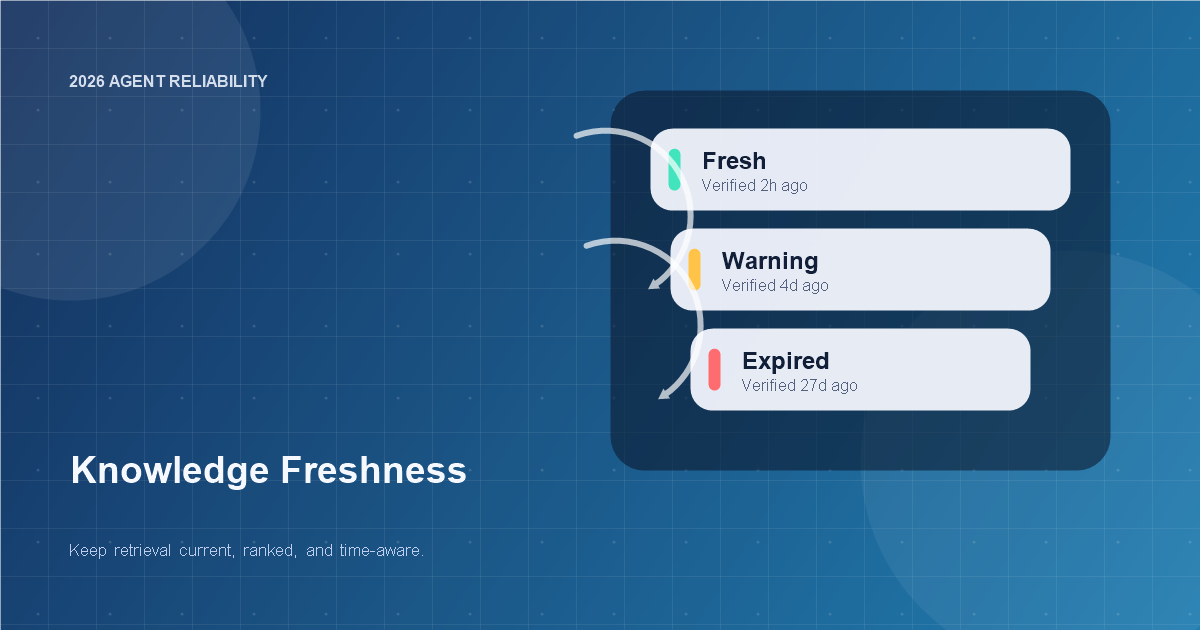
- If a source is mildly stale, allow retrieval but add a freshness warning
- If a source is significantly stale, demote it
- If a source is expired for the workflow, exclude it
- If all candidate sources are stale, ask for confirmation or escalate to a human
That last rule is important. A mature agent should know when the knowledge layer itself is suspect. Polite uncertainty beats confident fiction.
If this intersects with approvals in your workflow, pair it with /posts/human-handoff-playbook-for-ai-agents.
Add a freshness checkpoint before action
The closer the agent gets to taking a real action, the stricter freshness should become. Drafting a rough answer from week-old knowledge may be acceptable. Updating a customer contract from the same source probably is not.
Use a pre-action checkpoint:
- What sources support this action?
- How old are they?
- Are they authoritative?
- Has anything materially changed since indexing?
This can be lightweight. A policy function can score the evidence bundle and either approve, warn, or block. The key is that freshness is checked at the moment it matters, not just at ingestion time.
Watch for freshness drift in production
Freshness problems rarely show up as obvious errors. They appear as near-misses, confused users, or support staff quietly fixing the agent's work after the fact.
Track a few metrics:
- Percentage of responses backed by recently verified sources
- Percentage of runs that used stale-but-allowed knowledge
- Number of blocked actions due to expired evidence
- Source classes with the highest stale-answer complaints
If you are already instrumenting agent traces, route these metrics into the same operational view described in /posts/agent-observability-and-ops.
Freshness is not a one-time indexing job. It is an ongoing operational signal.
A practical pattern: hot, warm, and cold knowledge lanes
One effective setup is to split retrieval into three lanes:
- Hot lane: rapidly changing sources indexed frequently with aggressive expiration
- Warm lane: normal operational content refreshed on a schedule
- Cold lane: evergreen reference material with slower review cycles
This makes reasoning easier for both the system and the humans running it. The agent can pull policy and pricing from the hot lane, onboarding guidance from warm storage, and conceptual background from cold storage.
It also prevents a classic failure mode: throwing all content into one giant index and pretending "top-k" will sort out the mess.
Make the agent sound smart by letting it sound cautious
One of the most underrated UX upgrades is teaching the agent to mention freshness naturally:
- "I checked the latest published pricing page from this morning."
- "This policy was last verified three days ago."
- "I found an answer, but the source has not been revalidated since the product update."
That is not a weakness. It signals competence. In 2026, users are becoming more suspicious of frictionless certainty and more appreciative of systems that show their work.
Entertainingly enough, the most trustworthy agent in the room is often the one that knows how to say, "Give me ten seconds, I want to check the live source."
The rollout sequence that works
If your current retrieval stack has zero freshness controls, do this in order:
- Add source ownership and
last_verified_atmetadata. - Create three source classes with age thresholds.
- Demote archived, draft, and superseded content in ranking.
- Block stale evidence for high-risk actions.
- Add freshness metrics to your operations dashboard.
That sequence gives you useful protection quickly without forcing a full platform rewrite.
Summary
Freshness is now part of agent reliability, not a bonus feature for tidy teams. Classify sources by how fast they change, define freshness SLAs, rank for authority and recency together, and add pre-action checks where stale knowledge could cause real damage.
If your agent depends on retrieval, it does not just need a memory. It needs a sense of time.
Related Tools
Useful tools for this topic
If you want to turn this article into a concrete next step, start with one of these.
RAG Readiness
ArchitectureCheck whether your documents, freshness rules, and ownership model are strong enough for retrieval to work.
Open toolContext Selector
ArchitectureFigure out whether a given failure or task needs retrieval, memory, workflow state, or a clarifying question.
Open toolMemory Policy Builder
ArchitectureDefine what the system should remember, what it should avoid storing, and how that memory is corrected.
Open toolSubscribe to AgentForge Hub
Get weekly insights, tutorials, and the latest AI agent developments delivered to your inbox.
No spam, ever. Unsubscribe at any time.