
RAG Is Not a Strategy: When AI Agents Should Search, Remember, or Ask
RAG Is Not a Strategy: When AI Agents Should Search, Remember, or Ask
There is a point in almost every agent project where someone says, "Let's add RAG."
Usually this happens right after the first embarrassing failure. The agent answered with old information. Or it missed a policy detail that definitely exists somewhere in Notion. Or it sounded smart while being completely disconnected from the actual customer account it was supposed to help with.
So the team reaches for retrieval as if retrieval were a universal solvent. Plug in a vector database, chunk a few hundred documents, wire up a query step, and call it architecture.
I understand the instinct. I have done it too.
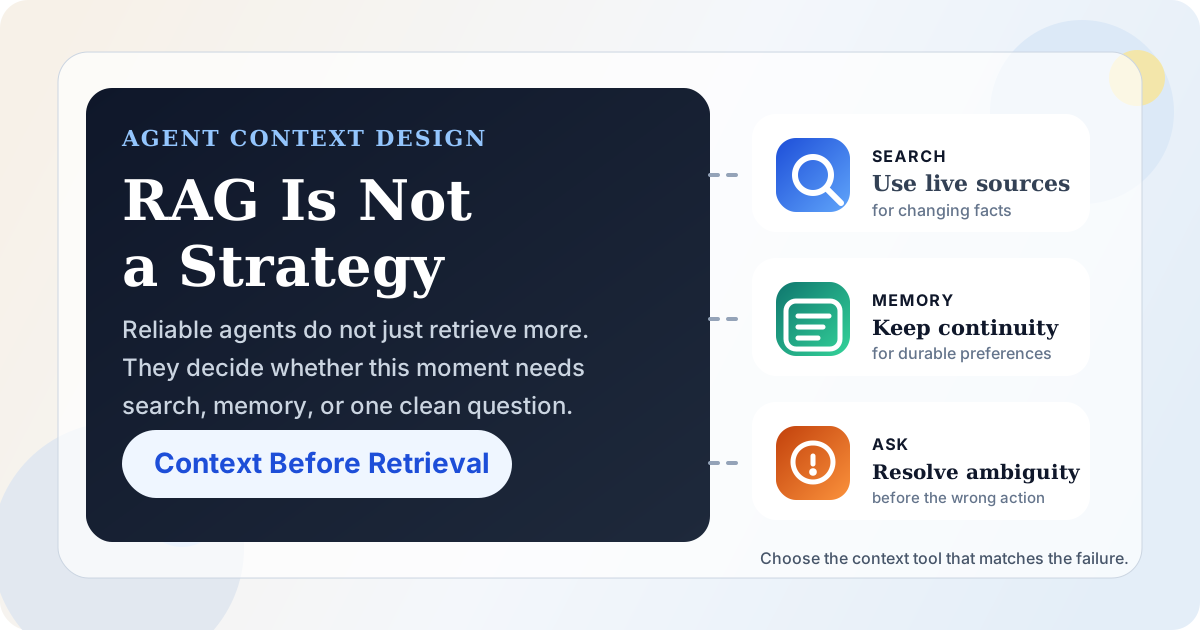
But after enough production systems, you start to notice something uncomfortable: a lot of "RAG problems" are not retrieval problems at all. They are context problems. More specifically, they are failures to separate three very different needs:
- The agent needs outside knowledge.
- The agent needs continuity about this user or this workflow.
- The agent does not know enough yet and should ask one more question.
Those are not the same thing. Treating them as the same thing is how teams end up with expensive, noisy systems that retrieve too much, remember too little, and still confuse users.
That is why RAG is not a strategy. It is a technique. Sometimes an important one. But if you make it your default answer to every reliability problem, you are going to build an agent that searches constantly because it was never taught how to think clearly about what kind of context it actually needs.
The mistake teams make early
The early version of an agent usually works surprisingly well in demos. You give it a narrow task, a few obvious examples, and a friendly user who already knows what they meant. It feels magical.
Then reality shows up.
A customer asks, "Can you update my renewal settings to match last quarter?"
That sounds straightforward until you unpack it.
What does "my" refer to in a multi-account environment? Which renewal settings? What happened last quarter? Is that in a CRM record, a billing system, an email thread, or somebody's memory of a meeting? Is the customer asking for information, or are they authorizing a real change?
This is where weak agent designs start spraying retrieval at the problem. They search everything. Product docs, old tickets, FAQs, previous chats, maybe even random internal notes. The result is often worse than having no retrieval at all. The agent finds fragments, mixes scopes, and answers with a tone of confidence that sounds much more authoritative than the evidence deserves.
What was needed might not have been search. It might have been account memory. Or a permissions check. Or one clarifying question: "Do you mean the renewal settings on your enterprise contract, or the per-workspace subscription defaults?"
That question can be worth more than ten nearest-neighbor matches.
Search, memory, and questions solve different problems
Once you see the distinction, a lot of agent design becomes less mystical.
Search is for information the agent does not carry with it and cannot safely infer. Good search is grounded in external sources that can change. Policies, product specs, compliance rules, inventory, pricing, recent tickets, vendor documentation. Search is what keeps the agent from pretending that yesterday's knowledge is still current.
Memory is different. Memory is not "everything the model saw before." That is how you create a junk drawer. Useful memory is specific continuity that helps future interactions go faster or become more personalized. A user's preferred report format. The fact that a team uses Azure, not AWS. A known naming convention in their codebase. A prior decision that should carry forward until explicitly changed.
Questions are different again. Questions are what the agent should do when the cheapest path to correctness is to stop guessing. This is the most underused move in agent design because teams are afraid it makes the system look less capable. In practice, the opposite is true. A well-timed clarifying question is one of the clearest signals that the system understands risk.
An experienced operator eventually learns to ask, before every context feature: is the problem missing knowledge, missing continuity, or missing certainty?
If you do not answer that first, your architecture is already drifting.
When search is the right move
Search earns its keep when the answer lives outside the current working context and is likely to change over time.
That includes obvious cases such as product documentation, support knowledge bases, internal runbooks, and regulatory requirements. It also includes less obvious operational data: open incidents, recent deployment notes, account status, or the latest policy exception approved by legal three days ago.
The key is that search should be tied to a source you can point to.
In production, I do not trust retrieval just because the chunks look semantically similar. I trust it when the source is authoritative enough for the action being taken. That distinction matters. A community forum answer and an internal policy document are not interchangeable evidence. Neither are a two-year-old PDF and a live system record.
This is why many retrieval systems disappoint. The embeddings are fine. The ranking is fine. The problem is that the source set is a mess. Teams feed everything into one index and act surprised when the agent returns something that is technically related but operationally useless.
Good retrieval starts with source discipline.
Ask:
- Is this source authoritative for the decision at hand?
- How quickly does it go stale?
- Should it be cited, summarized, or only used for internal reasoning?
- Does the agent need one answer, or does it need cross-source confirmation?
If the answer can materially affect money, security, compliance, or customer state, I want retrieval to be narrow, sourced, and visible. The agent should be able to say what it checked, not just produce a polished paragraph.
When memory is the right move
Memory is where a lot of agent systems become either genuinely useful or quietly dangerous.
The temptation is to store everything because storage is cheap and future usefulness feels plausible. Resist that temptation. Most long-term memory systems fail not because they forget too much, but because they remember too much without structure.
Practical memory is selective. It should capture stable preferences, durable facts, and decisions that will predictably matter later.
Good examples:
- "This team prefers Terraform examples over CloudFormation."
- "The user wants summaries first, raw logs second."
- "Use the staging workspace for dry runs unless they explicitly ask for production."
- "This customer calls the integration gateway 'the broker layer' internally."
Bad examples:
- Every sentence from every chat.
- Every intermediate plan the agent brainstormed.
- Half-formed conclusions that were never confirmed.
- A guessed preference that the user never actually stated.
Memory should reduce friction, not create folklore.
The design rule I use is simple: if the fact would sound reasonable in a human handoff note, it might deserve memory. If it sounds like a transient artifact of one conversation, it probably does not.
And one more thing: memory needs expiration and correction paths. If a user changes their preference, the system should not cling to the old one like a stubborn coworker who never read the updated brief.
When the best move is to ask
This is the part that usually separates demo agents from dependable ones.
A lot of failures do not come from missing data. They come from unresolved ambiguity. The agent has enough information to sound plausible, but not enough information to act safely.
That is when it should ask.
Not with a five-question interrogation. Not with the sort of robotic form-filling prompt that makes users feel like they are debugging your architecture. Just one clean question that collapses uncertainty.
For example:
- "Do you want the latest public policy, or the internal exception used by your team?"
- "Are you asking me to explain the failed deployment, or to roll it back?"
- "Should I use your saved preferred vendors, or compare the full market again?"
That kind of question does three useful things at once. It reduces hallucination risk. It makes the user feel understood. And it prevents the system from wasting time retrieving or reasoning across branches it never needed.
One of the best heuristics in agent design is this: if the branching factor is high and the cost of being wrong is non-trivial, ask before you search more.
A practical decision rule
If you want a rough field guide, use this:
Search when the answer depends on external or changing information.
Remember when the answer depends on stable user, team, or workflow continuity.
Ask when multiple interpretations are still live and the cost of choosing the wrong one is meaningful.
And if none of those apply, do not reach for another subsystem. Sometimes the model already has enough local context to complete the task. Not every interaction needs retrieval, memory writes, and orchestration logic wrapped around it like an overbuilt enterprise sandwich.
One of the easiest ways to make an agent slower and less reliable is to make every request walk through every possible capability whether it needs it or not.
What this looks like in a real system
Imagine you are building an agent for a platform team inside a mid-sized SaaS company. Engineers use it to answer operational questions, draft changes, and look up internal guidance.
A weak design says: every prompt goes through retrieval.
A stronger design says:
First, classify the request. Is this about public knowledge, internal docs, live system state, user preference, or an action with side effects?
Second, load only the context that matches that class. If the user is asking, "What is our current incident escalation policy?", retrieve the policy. If they are asking, "Format this in the style I usually send to leadership," load preference memory. If they say, "Re-run the last thing we did but for the Europe region," the system should probably ask which environment and confirm permissions before doing anything else.
Third, write memory sparingly. If the user corrected a preference or approved a durable default, store that. If the exchange was a one-off exception, do not.
That sounds less glamorous than "full agentic architecture," but it is how systems stay sane after month three.
Why teams overuse RAG
Part of it is tooling. Retrieval stacks are easy to buy, easy to prototype, and easy to explain to stakeholders. "We connected the model to our documents" sounds like progress.
Part of it is organizational psychology. Search feels safer than memory because it appears more objective. It also feels safer than asking questions because it preserves the illusion that the agent is independently capable.
But mature systems care less about illusion and more about failure modes.
An over-retrieving agent tends to fail noisily but politely. It gives a dense answer with a few sourced-looking details and hopes nobody notices the scope mismatch.
An under-asking agent fails in a way users remember. It changes the wrong thing, references the wrong account, or confidently answers a question that should have triggered a clarification.
An undisciplined memory system fails slowly. That is the hardest one to debug because the model starts carrying around old assumptions that feel personal and specific, which makes the mistakes look eerily intentional.
Every one of those patterns comes from the same root issue: the system never learned to distinguish knowledge retrieval from continuity from uncertainty.
The architecture I recommend for most teams
For most small and mid-sized teams, you do not need a heroic stack. You need a clean one.
I would start with four layers.
The first is request classification. Nothing fancy. Just enough logic to decide whether the task appears to need search, memory, clarification, or direct execution.
The second is scoped context loading. Retrieval should pull from the smallest authoritative source set that fits the request. Memory should load only the durable facts relevant to this user, account, or workflow.
The third is an uncertainty gate. Before the agent takes an action or presents a high-confidence answer, check whether ambiguity remains. If it does, ask.
The fourth is controlled memory writing. Only write facts that are durable, attributable, and useful later. Give them owners, timestamps, and a way to be corrected.
That is not flashy, but it is robust. More importantly, it creates a system you can explain to another engineer without drawing six boxes labeled "context intelligence layer."
The question I ask during design reviews
When I review an agent design, I usually ask one annoying question:
"What exactly is the agent missing at the moment it fails?"
Not in abstract terms. Specifically.
Is it missing a live source? Is it missing a durable user fact? Is it missing permission? Is it missing one piece of clarification that the user could provide in five seconds?
If the team cannot answer that cleanly, they are not ready to add another retrieval pipeline. They need a better failure analysis first.
This sounds obvious, but it is surprisingly rare. Teams often analyze the symptom, not the missing context type. Then they pile on infrastructure and wonder why the agent gets more expensive without getting much better.
A better way to think about "agent memory"
One last point, because this term causes endless confusion.
"Memory" makes people imagine a human-like internal continuity. That framing creates more heat than light. In practice, useful agent memory is usually just a well-governed store of durable context with clear retrieval rules.
That is good news. It means you do not need to solve synthetic consciousness to build a useful assistant. You need to decide what deserves to persist, under what conditions, and for how long.
If you treat memory as a product surface instead of a magical emergent property, the design gets much better. Users should be able to understand what the system tends to remember, what it forgets, and how to correct it.
That is not just good UX. It is operational hygiene.
Closing thought
The strongest agent systems I have seen do not win by retrieving more. They win by being choosy.
They search when freshness matters. They remember when continuity matters. They ask when uncertainty matters.
And they do not confuse those moves with one another.
That is the real shift. Not "add RAG," but "be precise about what kind of context this moment requires."
Once you build from that premise, your agents get calmer. Cheaper, too. They stop thrashing through irrelevant documents and stop treating every conversation like a memory-writing ceremony. More importantly, they start behaving like systems that understand the difference between knowing, remembering, and needing to ask.
That is not as catchy as "just add retrieval."
It is also how you build something people can trust.
Related Tools
Useful tools for this topic
If you want to turn this article into a concrete next step, start with one of these.
Context Selector
ArchitectureFigure out whether a given failure or task needs retrieval, memory, workflow state, or a clarifying question.
Open toolRAG Readiness
ArchitectureCheck whether your documents, freshness rules, and ownership model are strong enough for retrieval to work.
Open toolMemory Policy Builder
ArchitectureDefine what the system should remember, what it should avoid storing, and how that memory is corrected.
Open toolSubscribe to AgentForge Hub
Get weekly insights, tutorials, and the latest AI agent developments delivered to your inbox.
No spam, ever. Unsubscribe at any time.