
Context Engineering for AI Agents: Design the Input Pipeline, Not Just the Prompt
Context Engineering for AI Agents: Design the Input Pipeline, Not Just the Prompt
Prompt engineering was the right obsession for the first wave of AI apps.
You wrote better instructions, added examples, tightened the tone, and hoped the model followed the script. That worked well enough when the task was short, the context was obvious, and the model only had to answer.
Agents changed the job.
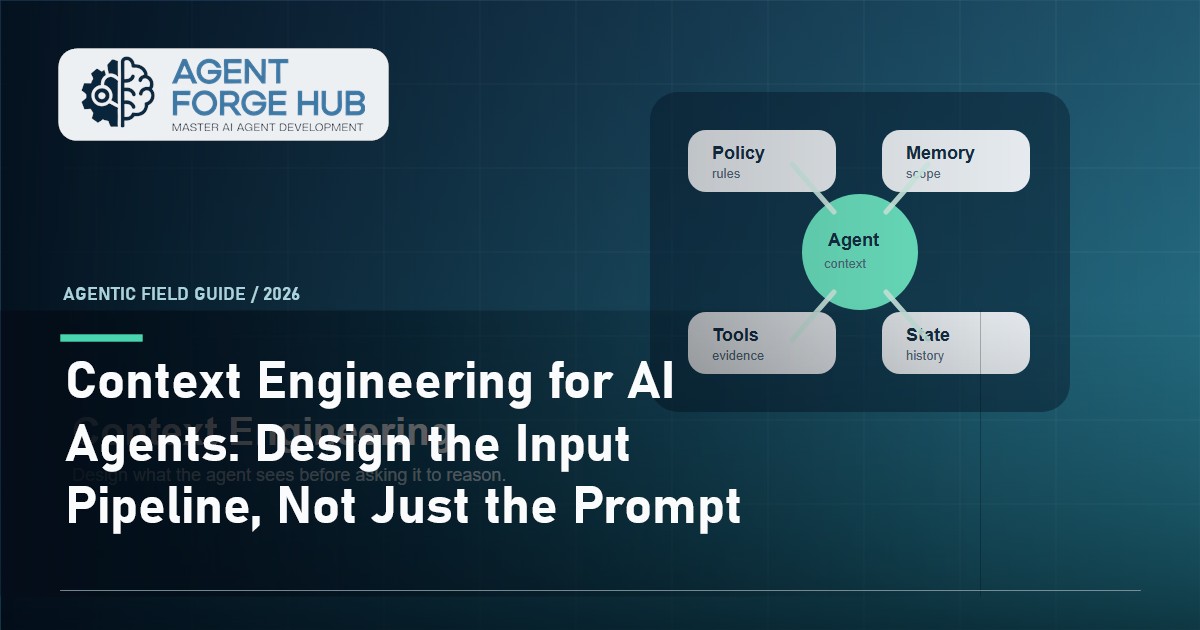
An agent has tools, memory, permissions, state, policies, retrieved documents, user preferences, traces, and partial work from earlier steps. The prompt is still important, but it is no longer the whole control surface. The real question is not just "What should we tell the model?" It is:
What should the model know at this exact moment, and what should be deliberately hidden?
That is context engineering.
TL;DR
Context engineering is the discipline of designing the information pipeline around an agent. It decides which instructions, state, memory, documents, tool results, policies, and evidence enter the model window at each step. Good context engineering reduces hallucinations, lowers cost, improves auditability, and keeps agents from confusing similar but separate facts.
Why prompt engineering is not enough
Prompts are instructions. Context is evidence.
A beautiful system prompt cannot save an agent that is looking at the wrong account, stale policy, irrelevant memory, or ten pages of retrieved noise. In production, many agent failures look like reasoning failures but start as context failures.
Common examples:
- the agent retrieves a deprecated document
- the agent remembers a preference from the wrong workspace
- the agent sees tool output without knowing whether it succeeded
- the agent gets a giant transcript when it needed three facts
- the agent has policy rules but not the evidence needed to apply them
When this happens, teams often blame the model. Sometimes the model is the problem. More often, the model was handed a messy desk and asked to act confident.
The context stack
Think of agent context as a layered stack:
- Instructions: what the agent is supposed to do
- Role and policy: what it is allowed to do
- Task state: what has happened in this run
- User state: who the agent is helping and under what authority
- Retrieved knowledge: documents, records, and external facts
- Memory: durable preferences, past decisions, and useful history
- Tool evidence: outputs, errors, and confirmations from actions
- Output contract: what shape the answer or action must take
The mistake is dumping all of this into the model every time. Each step needs a different slice.
A planning step may need goals and policy. A tool step may need schema and IDs. A final answer may need citations and user-facing constraints. A human approval step may need evidence, risk, and an action preview.
Context engineering is deciding that slice intentionally.
Build context bundles, not context piles
A context bundle is a curated packet for a specific agent step.
For example, before an agent changes a billing setting, the bundle might include:
- normalized user intent
- account ID and permission scope
- current billing state
- relevant policy excerpt
- proposed change
- risk tier
- approval requirement
That is much better than handing the model the entire account history, support transcript, billing docs, and vague instruction to "be careful."
Bundles make behavior easier to test because the inputs are clear. They also make review easier because you can inspect what the agent actually saw.
Retrieval is only one source of context
Retrieval gets too much credit and too much blame.
Some questions need search. Some need memory. Some need live tool state. Some need one clarifying question. If your agent treats every uncertainty as a retrieval problem, it will become slower, more expensive, and less precise.
Use a simple router:
- Need general external knowledge? Search or retrieve.
- Need continuity about this user? Load scoped memory.
- Need current system state? Call a tool.
- Need permission? Check policy and identity.
- Need missing intent? Ask.
That router is often more valuable than a fancier embedding model.
For a deeper version of this distinction, see /posts/rag-is-not-a-strategy.
Summaries should have jobs
Teams love summaries because they compress context. They also quietly destroy useful detail.
A good summary has a job:
- decision summary
- evidence summary
- user preference summary
- incident timeline
- open questions
- action history
Avoid generic "conversation so far" summaries. They blur facts, opinions, and actions into one mushy paragraph. Instead, store structured summaries with labels and timestamps.
The question should always be: what future decision will this summary support?
Keep context scoped
Scope is where many agent systems get dangerous.
An agent helping one user should not see another user's memory. A support workflow should not inherit admin context from a previous diagnostic run. A low-risk task should not see credentials, sensitive logs, or irreversible action tools.
Context scope should follow:
- tenant
- user
- workspace
- task
- permission level
- risk tier
- time window
If this sounds like authorization, it is close. Context is a form of power. What the model can see shapes what it can do.
Pair this with /posts/agent-permissions-are-product-design if your agent can take action.
Measure context quality
You cannot improve context engineering if you only track final success.
Track:
- retrieved documents used in accepted outputs
- stale or rejected context rate
- average context size by workflow
- tool calls avoided through better state
- clarification rate
- context-related failure labels
When a run fails, ask whether the model made a bad inference or whether the input bundle was incomplete, noisy, stale, or overbroad.
This is where observability matters. The trace should show not only what the model answered, but what context was assembled and why.
A practical rollout plan
Start small:
- List the top five workflows your agent handles.
- Define the exact context bundle each workflow step needs.
- Add freshness and scope metadata to retrieved material.
- Replace generic summaries with task-specific summaries.
- Log context assembly decisions in your traces.
That sequence usually improves reliability faster than rewriting prompts.
Summary
Context engineering is the production version of prompt engineering. It treats the model window as a scarce, powerful surface that should be assembled with intent.
The best agents in 2026 will not be the ones with the longest prompts. They will be the ones that know what to show the model, what to hide, what to refresh, and when to ask one more question.
Related Tools
Useful tools for this topic
If you want to turn this article into a concrete next step, start with one of these.
Context Selector
ArchitectureFigure out whether a given failure or task needs retrieval, memory, workflow state, or a clarifying question.
Open toolMemory Policy Builder
ArchitectureDefine what the system should remember, what it should avoid storing, and how that memory is corrected.
Open toolRAG Readiness
ArchitectureCheck whether your documents, freshness rules, and ownership model are strong enough for retrieval to work.
Open toolSubscribe to AgentForge Hub
Get weekly insights, tutorials, and the latest AI agent developments delivered to your inbox.
No spam, ever. Unsubscribe at any time.