
Evidence Provenance for AI Agents: How to Make Every Important Claim Traceable
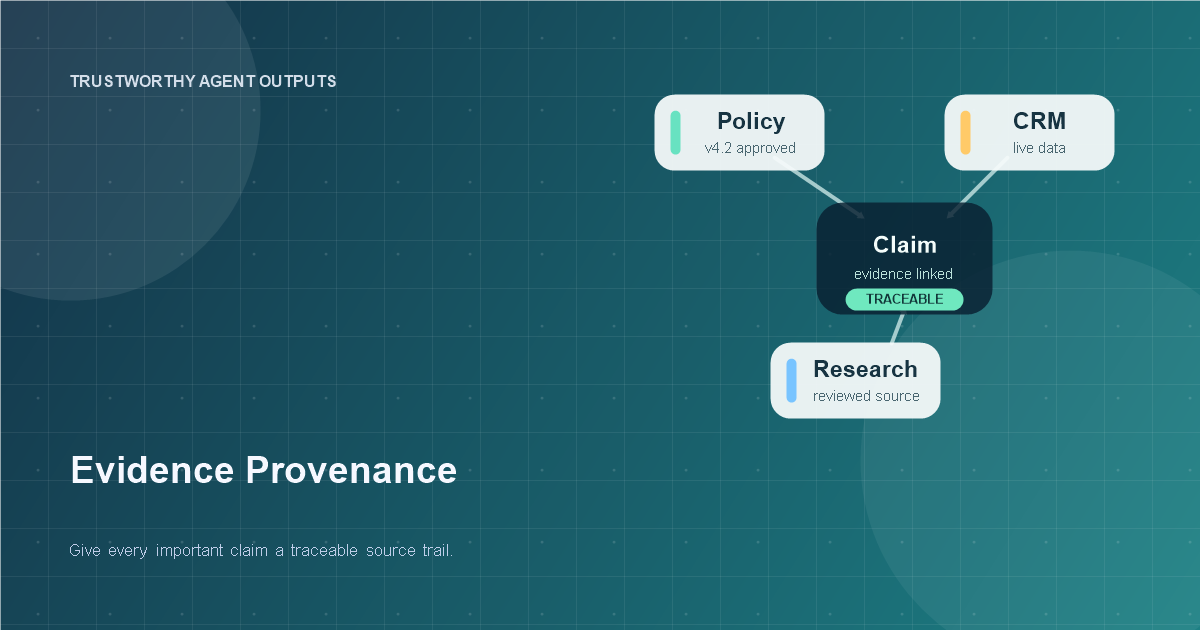
Evidence Provenance for AI Agents: How to Make Every Important Claim Traceable
An agent that produces a persuasive answer is not necessarily an agent that produces a defensible one. This distinction becomes painful the moment an agent drafts a customer response, recommends an operational action, or summarizes a policy. Someone eventually asks a simple question: How do we know that?
If the system can only answer, "the model said so," it has a trust problem. If it can point to the source, identify the version it used, explain which part supports the claim, and flag uncertainty, it becomes reviewable work rather than opaque automation.
This article explains how to design that second kind of system. The goal is not to make every sentence look like an academic paper. It is to give humans enough evidence to verify consequential claims quickly and to prevent unsupported assertions from quietly flowing into production.
The core distinction: retrieved text is not provenance
Teams often treat retrieval as proof. An agent finds a document, inserts part of it into its context, and returns an answer with a link. That is useful, but it is not enough.
Provenance answers a broader set of questions:
- Which source supported this specific claim?
- Which version of that source was used?
- When was the source last verified or updated?
- Did the agent infer, summarize, or directly quote the information?
- Did other credible sources disagree?
- Can a reviewer reproduce the answer from the same inputs?
An answer can contain a relevant citation and still overstate what the citation says. A source can be authoritative but stale. Two systems can store the same document with different parsing or access rules. Provenance makes these differences visible.
The design principle is simple: store evidence as a first-class output of the workflow, not as decoration added after generation.
Start with a claim model, not a citation widget
The most reliable implementation unit is a claim, not a document. A document may support only one sentence in a long answer. Conversely, a single claim may require several sources.
For each material claim, capture a compact evidence record:
| Field | Why it matters |
|---|---|
claim_id |
Lets a reviewer and downstream system refer to one assertion precisely. |
claim_text |
States the assertion being supported. |
source_id and source_version |
Identifies the exact source and revision used. |
source_locator |
Points to a page, heading, table row, API record, or timestamp. |
support_type |
Distinguishes direct support, synthesis, calculation, and inference. |
retrieved_at |
Shows when the agent observed the source. |
freshness_policy |
Defines how old the evidence may be for this task. |
confidence |
Reports support strength, not the model's general self-confidence. |
conflicts |
Preserves unresolved contrary evidence. |
This structure separates an answer's prose from the evidence that justifies it. It also prevents a common failure mode: citations appended to a polished response after the agent has already decided what it wants to say.
Support types should be explicit
Do not let a citation imply more than it proves. A four-value support taxonomy is usually enough:
- Direct: the source states the claim in substantially the same terms.
- Synthesis: multiple sources jointly support a conclusion.
- Calculation: the claim is derived from cited inputs and a declared method.
- Inference: the claim is a reasoned conclusion that goes beyond what a source literally says.
Inference is not a defect. Hidden inference is. A reviewer can accept a clearly labeled inference with appropriate caveats; they cannot responsibly review one disguised as a fact.
Design the workflow around evidence before generation
Provenance works best when it shapes the agent loop. A practical flow has five stages.
1. Classify the request by consequence
Before retrieval, determine what kind of output the user is asking for. A brainstorm, a product comparison, and a compliance answer should not share the same evidence standard.
Classify the request by consequence:
- Low consequence: ideation, copy drafts, internal summaries.
- Moderate consequence: recommendations, plans, customer-facing explanations.
- High consequence: legal, financial, security, medical, or production-changing actions.
Then set requirements. High-consequence outputs may need approved source domains, current evidence, claim-level support, and an explicit human approval step. Low-consequence outputs can use a lighter approach. This is proportional control, not bureaucracy.
2. Retrieve from an inventory, not an undifferentiated index
Every source should have metadata before it becomes available to an agent. At minimum, maintain:
- An owner responsible for source quality.
- A source class, such as policy, product record, support article, or external research.
- An authority level for the task type.
- A version or content hash.
- A review date and freshness expectation.
- Access and usage restrictions.
This lets the agent prefer a current policy over an old slide deck, or a system-of-record API over a manually exported spreadsheet. The retrieval problem becomes "find admissible evidence" rather than merely "find semantically similar text."
3. Extract evidence spans before drafting
For each candidate source, capture the smallest passage or structured field that supports the potential claim. Keep its locator and content hash alongside the extracted text.
This matters because later regeneration can otherwise change the wording of an answer while preserving a vague document link. A stored evidence span makes the support inspectable and allows the system to tell whether the source actually backs the revised wording.
4. Build a claim-evidence map
Have the agent draft an internal table before it writes final prose:
| Proposed claim | Evidence | Support type | Open issue |
|---|---|---|---|
| "The plan renews annually." | Contract section 4.2 | Direct | Confirm contract version |
| "Renewal risk is rising." | Usage decline plus support tickets | Inference | Needs account-owner review |
The table can remain internal, but it gives the generation step a contract: do not state a material claim unless it has evidence or is explicitly framed as an assumption, recommendation, or question.
5. Render an answer built for review
Put evidence where the review happens. Dense inline citations are not always the best interface. Depending on the workflow, use:
- Source chips beside consequential claims.
- Expandable evidence panels with the exact supporting passage.
- A "what changed" view when the same question is answered later.
- A short uncertainty section for conflicts, gaps, and stale sources.
The right experience reduces verification time. It should not turn every interaction into a forensic exercise.
Treat freshness as a policy decision
Freshness is contextual. A company founding date may be stable for years; a pricing rule or service status may be stale within hours. One global "last updated" threshold creates both false alarms and blind spots.
Define freshness by source class and use case. For example:
| Use case | Example freshness rule |
|---|---|
| Live operational recommendation | Verify system-of-record data at run time. |
| Product-policy answer | Use the currently published policy version. |
| Quarterly planning brief | Flag sources older than one quarter for review. |
| Historical analysis | Preserve the source version that was valid at the period being analyzed. |
An agent should never silently convert old evidence into a present-tense claim. When evidence is outside its freshness policy, it should retrieve again, qualify the statement, or ask for review.
Handle conflicts without averaging them away
Conflicting sources are information, not noise. A shallow agent picks one and continues. A reliable agent records the conflict and applies a decision rule.
Good rules are domain-specific:
- Prefer the system of record over a derivative report.
- Prefer a source with a clear owner and newer approved version.
- Preserve a conflict when source authority is equal or unclear.
- Escalate if the conflict changes a high-consequence decision.
Avoid using a model's confidence score to break factual ties. Confidence measures the model's disposition toward an answer, not which source governs. Authority, recency, and task policy are the appropriate controls.
Make provenance useful to humans
A provenance system fails when reviewers ignore it because it is too noisy. The answer is progressive disclosure.
At the surface, show only what changes a decision: source title, freshness state, support type, and any unresolved conflict. Let a reviewer open the exact excerpt and version details when needed. Reserve full retrieval traces, prompts, and tool logs for debugging or audit views.
This keeps the default experience legible while preserving the evidence trail needed for serious review.
Measure whether traceability is working
Do not measure provenance by the number of links in an answer. Measure its practical effect.
Useful metrics include:
- Claim coverage: percentage of material claims with admissible evidence.
- Verification time: median time for a reviewer to confirm a claim.
- Unsupported-claim rate: claims a reviewer cannot validate from the attached evidence.
- Stale-evidence rate: outputs relying on evidence outside the relevant policy.
- Conflict-resolution rate: conflicts resolved by an explicit source rule rather than an arbitrary choice.
- Reviewer override rate: how often humans reject or materially revise evidence-backed outputs.
Track these by workflow and consequence level. A lower coverage rate may be acceptable for exploratory research but unacceptable for an operational recommendation.
A 30-day implementation path
You do not need to rebuild your entire retrieval stack to gain real traceability.
Week 1: define the boundary. Pick one workflow where a wrong answer is costly but sources already exist. List the material claim types and the authoritative source for each.
Week 2: add source metadata. Give the selected sources owners, versions, freshness rules, and access labels. Capture exact locators during retrieval.
Week 3: introduce claim-evidence records. Require direct support for factual claims and label synthesis, calculation, and inference. Store conflicts rather than discarding them.
Week 4: run a review study. Compare a small set of outputs with and without evidence panels. Measure verification time, reviewer confidence, and the rate of unsupported claims. Use the results to simplify the interface and refine the policy.
The standard to aim for
Trustworthy agents do not merely provide answers with links. They make it possible to inspect how an answer was formed, identify which evidence was current and authoritative, and distinguish fact from inference.
That is not an academic luxury. It is what lets an organization delegate meaningful work without asking people to accept a black box. Build provenance at the claim level, enforce freshness and conflict rules in the workflow, and make the evidence easy to review. The agent will become more useful precisely because people can challenge it.
Related Tools
Useful tools for this topic
If you want to turn this article into a concrete next step, start with one of these.
Data Readiness
OperationsEvaluate completeness, consistency, recency, access control, and ownership in the data behind the system.
Open toolArchitecture Recommender
ArchitectureGet a recommended starting architecture based on autonomy, data shape, action model, and team profile.
Open toolSolution Type Quiz
PlanningDecide whether your use case is better served by automation, a chatbot, RAG, a copilot, or a more capable agent.
Open toolSubscribe to AgentForge Hub
Get weekly insights, tutorials, and the latest AI agent developments delivered to your inbox.
No spam, ever. Unsubscribe at any time.