
How to Buy an AI Agent Platform: A Proof-Driven Procurement Guide
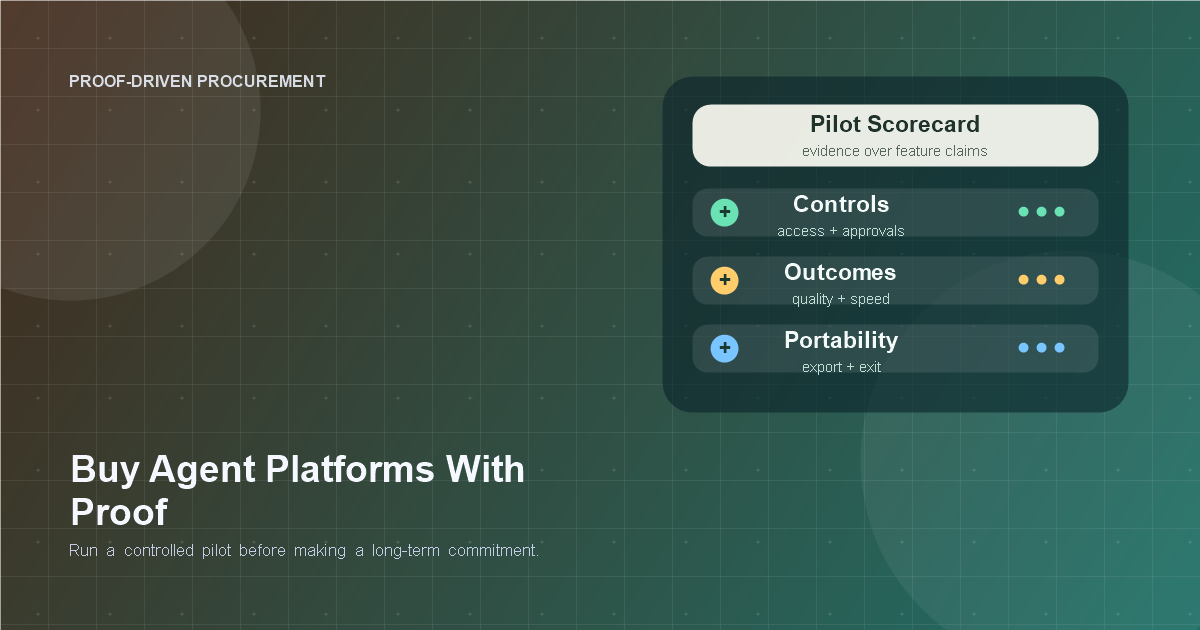
How to Buy an AI Agent Platform: A Proof-Driven Procurement Guide
Buying an AI agent platform is not like buying a conventional SaaS tool. The demo can be excellent, the feature list can be long, and the initial workflow can still fail in production because the platform cannot access the right data, enforce the right approvals, or stay understandable when something goes wrong.
The usual procurement reflex is to compare features: models, connectors, workflow builders, dashboards, and pricing tiers. That matters, but it is a poor primary decision tool. The buyer needs evidence that a platform can improve one important workflow under the organization's actual constraints.
This guide presents a proof-driven process. It is designed for teams buying an agent platform, not for teams selecting a single model API or a simple chat assistant.
Begin with a work unit, not a vendor category
"We need an agent platform" is too broad to evaluate. Start with a bounded work unit that has a clear owner, known inputs, and a measurable outcome.
Good candidate work units have these properties:
- They occur frequently enough to generate meaningful pilot data.
- The current process has visible friction, delay, or rework.
- A human can review or reverse the result during the pilot.
- The necessary systems and data can be accessed legitimately.
- Success can be measured without inventing a new scorecard.
Examples include preparing a sales-account brief from approved CRM and support data, triaging internal IT requests, or drafting a first response to a documented customer issue. "Improve productivity" is not a work unit. "Reduce the time to prepare an account brief while preserving manager approval" is.
Write the use case in one paragraph before you talk to vendors:
For [user], when [trigger] occurs, the agent will use [approved inputs] to produce or perform [bounded output/action]. A human will [review/approve/escalate] when [condition]. We will measure [outcome] against [baseline] over [period].
This statement becomes the basis for both the request for proposal and the pilot.
Establish non-negotiables early
Not every requirement deserves the same weighting. Separate true constraints from preferences before a vendor demo has a chance to shape them.
Common non-negotiables include:
- Identity integration and role-based access control.
- Data residency, retention, and deletion requirements.
- Audit logs sufficient for your risk and compliance obligations.
- Approval gates for consequential actions.
- Network, API, and connector requirements.
- The ability to export workflow definitions, logs, and evaluation data.
Portability deserves special attention. An agent platform will accumulate prompts, policies, integrations, workflow logic, and usage history. Ask what happens when the contract ends or when you need to move one workflow. Can you retrieve configuration, evidence, outputs, and evaluation results in a usable format? A technically possible export that requires weeks of professional services is not meaningful portability.
Evaluate the control plane, not just the demo agent
Vendors can make the agent appear capable in a controlled environment. Production value depends more on the control plane around it.
During evaluation, look for evidence in six areas.
1. Identity and authorization
The platform should make it clear who initiated a run, which identity accessed a system, and which permissions applied. Ask whether access is delegated per user, executed through a shared service identity, or both. Each model has implications for auditability and least privilege.
Test permission changes during the pilot. If a user loses access to a record, the agent should not retain a path to it through an overly broad connector.
2. Data handling and knowledge boundaries
Get concrete answers about data flow: where prompts, tool inputs, outputs, embeddings, and logs are stored; how long each is retained; and whether customer data is used for training. Do not settle for a generic security overview.
Also test document-level permissions, deletion propagation, and stale-content behavior. An agent that retrieves the right document but ignores its access control is not production-ready.
3. Action controls
Separate read capability from write capability. A platform should support different approval policies for drafting an email, creating a ticket, modifying a record, or initiating a financial action.
Ask to see how it handles idempotency, retries, partial failures, and duplicate actions. The attractive scenario is a successful action. The revealing scenario is a failed action halfway through a multi-step workflow.
4. Observability and reconstruction
When an output is challenged, can an operator see the input, tools used, material evidence, approval events, and final action? Can that record be accessed without granting every reviewer administrative privileges?
Ask the vendor to reconstruct a deliberately problematic run during the demo. If the explanation is vague or requires an engineer to search several systems, that operational cost belongs in the decision.
5. Evaluation and change management
Agent behavior changes when models, prompts, tools, connectors, and source data change. The platform should help you test a proposed change against a representative set of cases before it affects users.
Look for versioning, test datasets, release controls, and the ability to compare outcomes. A platform that only supports live experimentation will turn routine updates into a risk event.
6. Economics and limits
Understand the full cost model: platform fees, model usage, connector charges, implementation services, storage, overages, and premium support. Then test whether you can cap cost per run, per workflow, and per business unit.
The useful number is not cost per token. It is cost per accepted outcome. A platform that costs more per run can still be the better choice if it sharply reduces review time or rework.
Replace the feature matrix with a proof matrix
Feature matrices encourage check-box answers. A proof matrix asks what evidence will validate each requirement.
| Requirement | Proof needed | Pilot test | Decision rule |
|---|---|---|---|
| Access control | User-level enforcement | Revoke access during an active workflow | No restricted data appears after revocation |
| Approval policy | Configurable human gate | Attempt a write action without approval | Action is blocked and logged |
| Traceability | Run-level reconstruction | Review a seeded bad answer | Reviewer can identify evidence and action path |
| Reliability | Graceful failure behavior | Simulate an API timeout | No duplicate action; user sees recoverable state |
| Portability | Usable export | Export a pilot workflow and run history | Team can read and reuse the output without vendor tooling |
Score the proof, not the promise. Use three states: demonstrated, partially demonstrated, and unproven. A claim remains unproven until your team sees it work with your identity, data, and constraints.
Run a controlled pilot with an exit criterion
A pilot is an experiment, not an extended sales demo. Give it a fixed scope, a short duration, and clear exit criteria.
A strong pilot design includes:
- One workflow with a named business owner.
- A baseline for time, quality, throughput, or escalation rate.
- A representative test set including routine cases and known edge cases.
- A constrained user group with training and a feedback channel.
- Read-only or approval-gated access until the action path is proven.
- Predefined success thresholds and explicit failure conditions.
For example, a support-triage pilot might require: at least 80% correct routing on a reviewed sample, no critical misrouting, a 25% reduction in first-touch handling time, and an auditable record for every recommendation. The exact thresholds will differ, but they must exist before pilot results are visible.
Avoid measuring a pilot only by adoption. Users can enjoy a new interface while still producing no better outcomes. Measure quality, speed, exceptions, reviewer effort, and cost together.
Involve the people who will carry the risk
Procurement often becomes a relay between business sponsors, IT, security, procurement, and legal. That can lead to late surprises. Put the required decision-makers in the pilot design meeting instead.
Each group should own a specific question:
- Business owner: Does the workflow improve a real outcome?
- Frontline users: Is the output reviewable and usable under normal workload?
- IT and architecture: Does it fit the integration and operating model?
- Security and privacy: Are access, retention, and data-flow controls adequate?
- Legal and procurement: Are the contract, liability, support, and exit terms acceptable?
- Finance: Does the cost model hold at expected volume?
This is not a committee exercise for its own sake. It reduces the risk of proving value in a pilot only to discover an unworkable requirement during contracting.
Negotiate for the operating reality
The contract should reflect that the platform is a living system, not a static software install. Focus negotiations on operational facts:
- What service levels apply to the platform, connectors, and support response?
- How will the vendor disclose material changes to models, data handling, or subprocessors?
- What logs and configuration data can you retain and export?
- What happens to data at termination, including backups and embeddings?
- Which implementation tasks are included, and which trigger services fees?
- Who owns custom integrations, workflow definitions, and evaluation datasets?
Ask for these answers in the contract or security addendum, not only in a sales email. The difference matters when priorities change eighteen months later.
Warning signs that should slow the purchase
No single concern automatically disqualifies a vendor, but several of these together should pause the process:
- The vendor will not run a pilot against a realistic workflow.
- Critical capabilities are described as "on the roadmap" without a contractual commitment.
- The platform cannot explain why it took an action or what data it used.
- Pricing depends on variables the buyer cannot observe or cap.
- Workflow export is incomplete, proprietary, or only available through professional services.
- Security assurances are broad, but data-flow details are unavailable.
- The vendor's reference architecture assumes permissions broader than your organization can grant.
These are not merely procurement inconveniences. They are signals about the cost of operating the platform after the excitement of launch has passed.
A practical decision rule
Make the decision when three conditions are true:
- The pilot meets its outcome and safety thresholds on representative work.
- The platform demonstrates the controls your organization cannot compromise on.
- The total operating cost is credible at the next twelve months of volume, including review and support work.
If one condition is missing, extend only the test that resolves that uncertainty. Do not broaden the pilot into a vague platform evaluation. A narrow unanswered question is cheaper to investigate than a broad commitment is to unwind.
The bottom line
The best AI agent platform is not the one with the most impressive autonomous demo. It is the one that demonstrably improves a bounded piece of work while giving your organization appropriate control, visibility, and an exit path.
Define the work unit, convert requirements into tests, run a pilot with real acceptance criteria, and negotiate for portability. That process is slower than a feature comparison at the start, but it produces a decision you can defend when the agent is handling work that actually matters.
Related Tools
Useful tools for this topic
If you want to turn this article into a concrete next step, start with one of these.
Solution Type Quiz
PlanningDecide whether your use case is better served by automation, a chatbot, RAG, a copilot, or a more capable agent.
Open toolArchitecture Recommender
ArchitectureGet a recommended starting architecture based on autonomy, data shape, action model, and team profile.
Open toolEvaluation Plan Builder
OperationsBuild a first evaluation plan for answer quality, action safety, human review, monitoring, and rollback.
Open toolSubscribe to AgentForge Hub
Get weekly insights, tutorials, and the latest AI agent developments delivered to your inbox.
No spam, ever. Unsubscribe at any time.