
Most Teams Do Not Need Multi-Agent Systems Yet
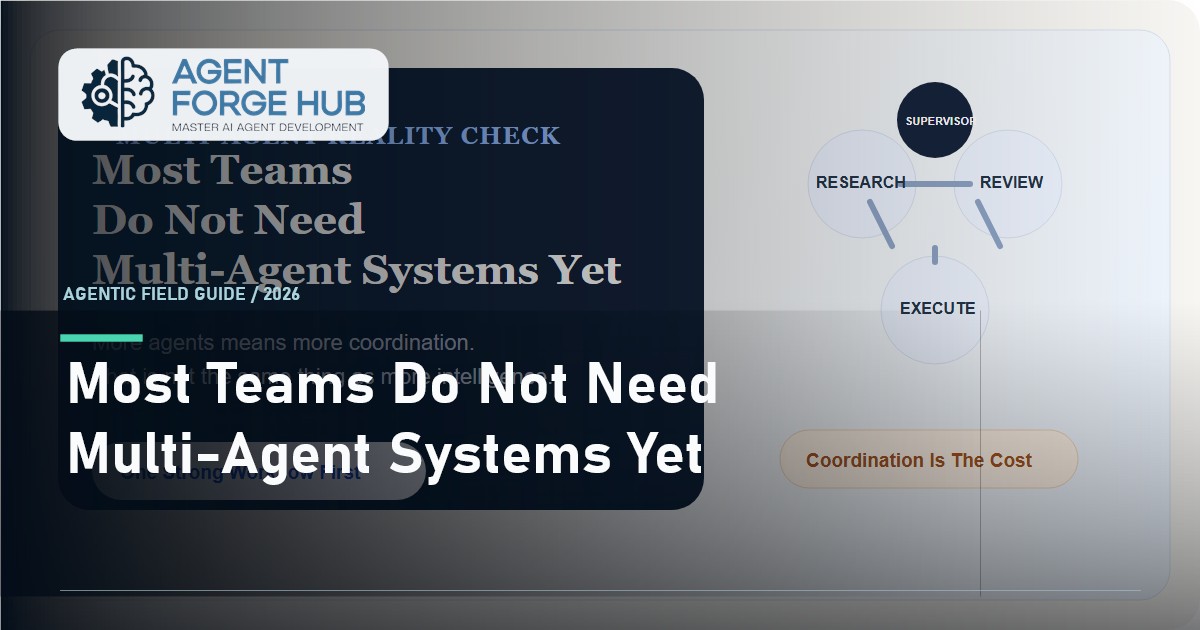
Most Teams Do Not Need Multi-Agent Systems Yet
If you spend enough time around agent builders, you will eventually hear the same progression.
First: "We built an agent."
Then: "It works, but it is doing too much."
Then, often much too quickly: "We should split it into multiple agents."
That leap is emotionally satisfying. It sounds architectural. It maps nicely onto how organizations already think about work: planner, researcher, reviewer, executor, supervisor.
And sometimes it is the right move.
But most teams reach for multi-agent systems before they have earned the complexity.
They have one agent that is not clearly scoped, one workflow that is still fuzzy, one evaluation loop that is still immature, and somehow the proposed fix is to add more moving parts.
That is not architecture. That is multiplication.
Why multi-agent designs are so seductive
They promise structure.
A single agent feels messy. It has too much context, too many responsibilities, and too many chances to drift. Breaking it into specialist roles sounds like a clean answer:
- a planner decides the approach
- a researcher gathers information
- a writer prepares the output
- a reviewer checks the work
On a whiteboard, that is beautiful.
In production, each handoff becomes a reliability problem.
Now you are not just evaluating task quality. You are evaluating:
- routing quality
- handoff fidelity
- state transfer
- responsibility boundaries
- failure recovery
- blame assignment when the final answer is bad
That is why multi-agent systems often feel smarter in demos than they do in operations. The surface area grows faster than the actual value.
The question teams skip
Before adding another agent, ask:
What specific failure would a second agent remove that a better single-agent workflow would not?
If you cannot answer that clearly, you are probably not ready.
A lot of "we need multiple agents" really means one of these:
- the prompt is overloaded
- the tool boundaries are weak
- retrieval is noisy
- workflow state is unclear
- evaluation is absent
- approvals were not designed properly
None of those are solved automatically by delegation.
When one strong agent is still the right answer
Most teams are better served, at least initially, by one explicit workflow agent with:
- good tools
- clean state
- clear guardrails
- strong observability
- human review where it matters
That sounds less exciting than a committee of agents. It is also much easier to debug.
If a task can be decomposed into steps but still belongs to one coherent job with one owner, one well-designed agent loop is usually enough.
You do not get extra points for pretending a workflow is an org chart.
Where multi-agent systems actually start to make sense
I start taking multi-agent design seriously when at least one of these is true:
1. The roles are genuinely different
Not "one agent thinks, another agent thinks more."
I mean truly different responsibilities, tool surfaces, or evaluation criteria.
For example:
- one agent gathers evidence from external sources
- one agent analyzes internal operational state
- one agent applies a domain-specific compliance or policy check
Those are different enough to justify separation because the boundaries are real.
2. The workflow benefits from parallelism
If the job requires collecting or processing several independent inputs at once, multiple agents can create real throughput gains.
This is one of the more credible reasons to split work. Not because parallelism sounds advanced, but because independent subproblems exist and can be recombined in a disciplined way.
3. The review function needs independence
Sometimes the system genuinely benefits from a reviewer that is not just another step in the same prompt chain.
This is especially true when:
- the stakes are high
- different evidence sources matter
- the review criteria are materially different from the generation criteria
Even then, I would still ask whether a structured second pass inside one workflow can accomplish the goal before introducing a fully separate agent.
The hidden cost is not tokens
People often talk about multi-agent systems in terms of cost per run. That matters, but it is not the most painful cost.
The real cost is coordination.
Every additional agent gives you more:
- prompts to maintain
- interfaces to stabilize
- logs to inspect
- states to reconcile
And once you add a supervisor or orchestrator, you now have a control problem on top of the task problem.
That can be worth it. It often is not.
This is why some of the best real-world multi-agent systems are surprisingly conservative. They do not spawn endless swarms. They use a small number of distinct roles with strict tool boundaries and obvious handoffs.
That is not an aesthetic choice. It is what keeps the system governable.
The test I like before splitting roles
I use a simple sequence:
- Get the single-agent version to work on real tasks.
- Identify repeated failure modes.
- Ask whether those failures come from overload, ambiguity, or true role conflict.
- Split only the part that has a clear boundary.
That order matters.
If you skip step one, you do not know whether the multi-agent design is solving a real problem or just formalizing confusion.
What good multi-agent boundaries look like
A strong boundary usually has three properties:
- distinct inputs
- distinct tools
- distinct success criteria
For example:
- a retrieval agent succeeds by finding grounded evidence
- a planning agent succeeds by choosing a sequence of actions
- a compliance reviewer succeeds by blocking unsafe or nonconforming actions
Those are different jobs.
What is not a strong boundary?
"Agent A drafts and Agent B redrafts."
"Agent A thinks and Agent B thinks harder."
"Agent A does research and Agent B also does research but differently."
Those are often just duplicated uncertainty.
Multi-agent systems need stronger operations, not weaker
Once several agents are involved, operations becomes more important, not less.
You need to know:
- who acted
- why they acted
- what context they had
- what they handed off
- what failed
- whether the failure came from the role, the routing, or the evidence
This is why orchestration matters more than people expect. A multi-agent system is not just several prompts working at once. It is a workflow engine with reasoning inside it.
And workflow engines punish vagueness.
The more useful framing
I think teams should stop asking, "How do we build a multi-agent system?"
The better question is:
"What task decomposition would reduce error, speed up work, or improve control enough to justify extra coordination?"
That framing is harder to romanticize, which is exactly why it is more useful.
Sometimes the answer will still be multi-agent. Good. At least now it is anchored in a system-level reason.
But often the answer will be:
- one better agent
- one clearer workflow
- one stronger review loop
- one cleaner retrieval layer
That answer is less flashy. It is also the answer that ships.
The short version
Most teams do not need multi-agent systems yet because they have not stabilized the simpler system underneath.
Multi-agent architectures make sense when:
- role boundaries are real
- parallel work is useful
- review needs independence
- operations can explain the handoffs
Until then, the extra agents usually create more coordination burden than intelligence.
Build the strong single-agent or single-workflow version first.
Then split it only where the boundaries are obvious enough that the complexity has somewhere to go.
Further Reading
Related Tools
Useful tools for this topic
If you want to turn this article into a concrete next step, start with one of these.
Pattern Selector
ArchitectureChoose between patterns like RAG assistant, workflow agent, approval-gated agent, or multi-agent setup.
Open toolArchitecture Recommender
ArchitectureGet a recommended starting architecture based on autonomy, data shape, action model, and team profile.
Open toolSolution Type Quiz
PlanningDecide whether your use case is better served by automation, a chatbot, RAG, a copilot, or a more capable agent.
Open toolSubscribe to AgentForge Hub
Get weekly insights, tutorials, and the latest AI agent developments delivered to your inbox.
No spam, ever. Unsubscribe at any time.