
When Local Models Actually Win: Cost, Privacy, Latency, and Control
When Local Models Actually Win: Cost, Privacy, Latency, and Control
There is a certain kind of confidence that appears in AI teams the first week they get a local model running.
The demo works. The responses stream back fast enough. Nothing leaves the machine. There is a feeling that the team has finally escaped the gravity of API pricing, rate limits, and external dependencies.
I understand the appeal.
Local models feel like sovereignty. They also feel, at least briefly, like maturity. As if hosted APIs were a temporary crutch and running your own inference were the grown-up version of the same thing.
Sometimes that is true.
A lot of the time, it is not.
Running models locally is not automatically better engineering. It is a trade. Sometimes a very smart one. Sometimes a very expensive way to inherit operational work you did not need.
The useful question is not, "Can we run this locally?" You usually can.
The useful question is, "Where do local models actually win hard enough to justify the extra surface area?"
The bad reason teams move local
The weakest reason to move local is status.
I have seen teams adopt local inference because it sounded more serious, more private, or more future-proof, without first proving that any of those benefits mattered to the use case in front of them.
That usually leads to a familiar outcome:
- worse task quality than expected
- more model selection churn than planned
- GPU and memory constraints showing up earlier than anyone budgeted for
- no one really owning the inference layer operationally
If the real bottleneck in your system is retrieval quality, permissions, or workflow design, changing where the model runs will not save you.
Local models solve specific problems. They do not solve vague disappointment.
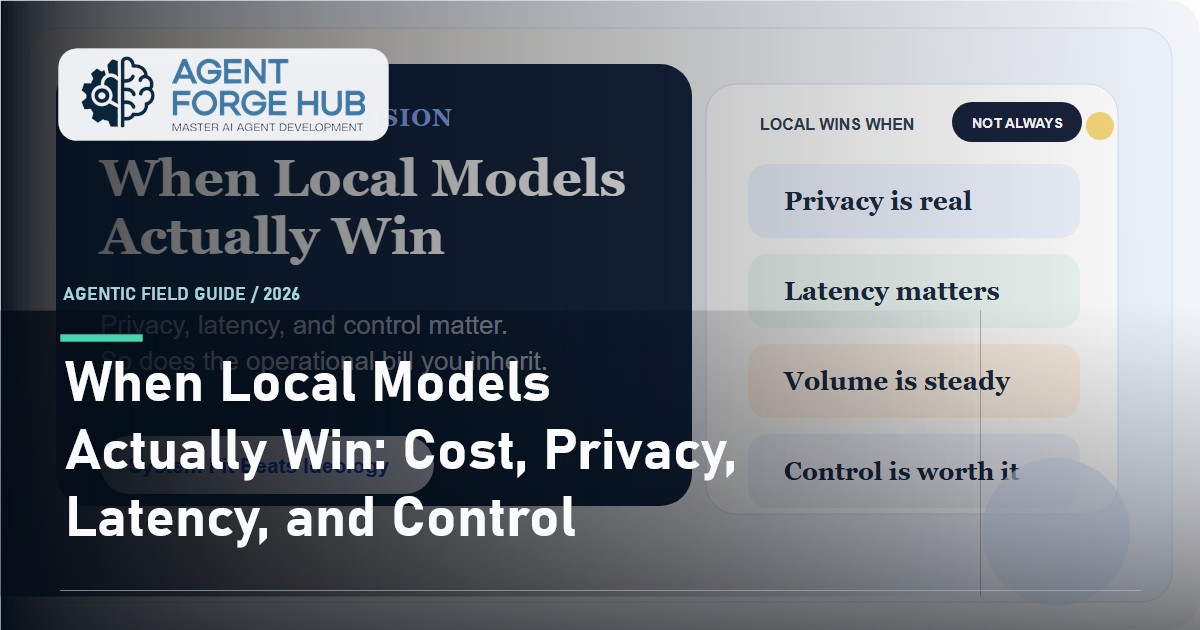
Where local models genuinely win
1. Privacy and data handling constraints
This is the obvious one, but it is still real.
If the workflow involves sensitive internal documents, regulated data, or environments where outbound model traffic is hard to justify, local inference can simplify the operating model dramatically.
That does not eliminate security work. You still need access control, logging discipline, retention rules, and sane tooling boundaries. But local inference can remove one major question from the room: "Why is this content leaving our environment at all?"
In some organizations, that is not just a technical preference. It is the difference between getting the project approved and spending six months in review.
2. Tight latency loops
There are workloads where network distance matters enough that local wins on feel alone.
Think:
- coding assistants operating inside the editor
- speech or realtime assistance in constrained environments
- short iterative loops where the model is called constantly
If every interaction has to leave the machine, wait on the network, and return, the user often feels that lag more than teams expect. A fast-enough local model can beat a larger hosted model if the loop becomes dramatically more responsive.
That matters because perceived responsiveness changes how people use systems. They experiment more. They stay in flow longer. They stop treating the assistant like a separate destination.
3. Predictable cost at steady volume
Hosted APIs are excellent when usage is uncertain, spiky, or still being proven.
Local models get more attractive when the workload becomes steady enough that owning the hardware and inference path gives you cost predictability.
The key word is predictability, not always lower cost.
Too many local-model arguments are framed as "APIs are expensive." Sometimes they are. But inference on your own hardware is only cheaper if the workload is stable enough, the quality is good enough, and the operational cost does not quietly eat the savings.
This is where teams fool themselves. They compare API spend to GPU spend and forget to price:
- time spent tuning and switching models
- infra monitoring
- fallback handling
- deployment friction
- performance debugging
- quality regressions that require prompt or workflow redesign
Local wins when the full operating picture still comes out ahead.
4. Control over deployment and failure modes
This is the least glamorous advantage and one of the most important.
When you own the inference path, you can make tighter decisions about:
- where the model runs
- what versions are deployed
- what fallback behavior exists
- how offline or degraded mode works
That matters for edge environments, isolated networks, and products where uptime and locality have to be explained clearly to customers or internal stakeholders.
Control is not free, but it is real.
Where local models usually lose
1. Quality-sensitive reasoning tasks
This is the part many teams learn the hard way.
For some workflows, especially complex synthesis, subtle instruction following, or messy real-world reasoning, a weaker local model can cost you much more in downstream orchestration than it saves in inference.
The team starts compensating:
- longer prompts
- more retries
- more tool calls
- more guardrails
- more post-processing
At that point, you are not really saving the complexity. You are moving it.
If the quality gap changes how many supporting systems you need, your cost model is wrong.
2. Teams without inference ownership
If nobody owns the local stack, do not pretend you have a local strategy. You have an experiment.
That is fine in prototyping. It is dangerous in production.
Local models need operational ownership. Someone has to care about model versioning, GPU fit, memory behavior, concurrency, failure recovery, and the ugly parts of keeping the service healthy when enthusiasm wears off.
Without that, the local setup becomes a fragile shrine everyone is afraid to touch.
3. Highly variable demand
If usage is erratic or still small, hosted APIs are often the more rational choice.
You get elasticity, better baseline quality, and less infra responsibility while you are still learning what the product really needs.
Many teams move local before they have even stabilized the task. That is backwards. First learn what good looks like. Then decide where it should run.
The decision framework I trust more than ideology
I like to score the move across four dimensions:
- Privacy pressure
- Latency sensitivity
- Volume stability
- Quality tolerance
If privacy and latency are high, and the quality bar is within reach for a local model, the case gets stronger fast.
If quality tolerance is low and usage is still unpredictable, hosted usually remains the better default.
That is why the most sensible real-world setups are often hybrid.
Use hosted models where you need top-end reasoning. Use local models where privacy, responsiveness, or cost predictability matter more than frontier quality.
That answer is less ideological, which is probably why it survives contact with operations.
Local does not mean simple
One thing the Ollama ecosystem has done well is make local experimentation feel accessible. That is valuable. It lowers the barrier to actually testing whether a use case works on your own hardware.
But easy setup should not be confused with easy production.
Once the model becomes part of a real workflow, the familiar engineering questions come back:
- What happens when the model does not fit cleanly in VRAM?
- What is the fallback when the machine is saturated?
- How do you monitor degraded latency?
- What models are approved for what tasks?
- What is the upgrade path when a better checkpoint appears?
The official Ollama docs and FAQ are useful because they remind you that local inference is not just "download and run." Hardware fit, memory placement, and concurrency behavior all affect the actual user experience.
That is exactly why local wins are contextual. They depend on the workflow and the operating model, not just the ideological appeal.
A better way to evaluate the move
If you are considering local, I would not start with a migration plan. I would start with a bake-off.
Take one real workflow and compare:
- task quality
- latency
- failure rate
- operating complexity
- effective cost over a representative week
Do not compare a hosted model in a vacuum to a local model in a vacuum. Compare both inside the actual workflow with the same retrieval, tools, and task structure.
That is where weak arguments tend to collapse.
Sometimes the local model is plenty good and the privacy or latency gains are obvious. Great. You have your answer.
Sometimes the hosted model is still worth every dollar because it reduces everything around it. Also a valid answer.
The point is to make the decision from the system, not from the vibe.
The short version
Local models win when the workflow truly benefits from:
- data staying close
- low-latency interaction
- predictable sustained usage
- tighter deployment control
They lose when teams underestimate:
- quality gaps
- infra ownership
- operational overhead
- the cost of compensating elsewhere
That is the whole game.
Run local when it changes the business or product equation in a meaningful way.
Do not run local just to feel advanced.
Further Reading
Related Tools
Useful tools for this topic
If you want to turn this article into a concrete next step, start with one of these.
Risk and Governance
OperationsIdentify where privacy, compliance, auditability, and action controls need to show up before rollout.
Open toolHuman-in-the-Loop Designer
OperationsDecide where approvals, review points, and escalation paths belong in the workflow.
Open toolSolution Type Quiz
PlanningDecide whether your use case is better served by automation, a chatbot, RAG, a copilot, or a more capable agent.
Open toolSubscribe to AgentForge Hub
Get weekly insights, tutorials, and the latest AI agent developments delivered to your inbox.
No spam, ever. Unsubscribe at any time.