
Agent-to-Agent Protocols: Why A2A Matters More Than Another Framework
Agent-to-Agent Protocols: Why A2A Matters More Than Another Framework
Agent teams are slowly discovering a very normal enterprise problem wearing a futuristic hat: systems need to talk to each other.
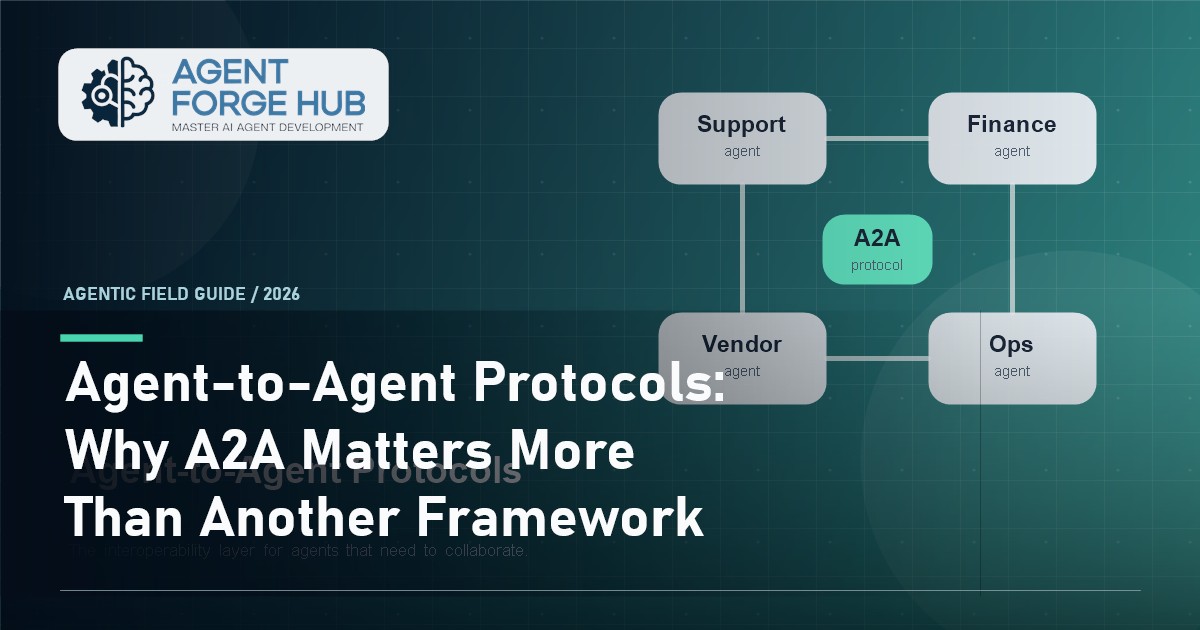
The first wave of agent work focused on making one assistant useful. Give it tools, memory, retrieval, policy checks, maybe a human approval step. That is still hard enough. But the next wave is uglier and more important: what happens when the support agent, finance agent, procurement agent, engineering agent, and vendor agent all need to coordinate without sharing a codebase, vendor, or runtime?
That is where Agent2Agent, usually shortened to A2A, becomes interesting.
Google introduced A2A in April 2025 as an open protocol for agent interoperability. By 2026, it is one of the most important signals that the agent ecosystem is moving from clever isolated workers toward networked systems. The point is not that A2A magically solves collaboration. The point is that it gives teams a shared language for discovery, task negotiation, messages, artifacts, and long-running work.
That is a bigger deal than another orchestration library.
TL;DR
A2A matters because agents need a standard way to communicate across products, clouds, and organizations. Use MCP when an agent needs tools and context. Use A2A when one agent needs to delegate work to, negotiate with, or receive artifacts from another agent. The hard part is not the wire protocol. The hard part is trust, identity, governance, and clean task boundaries.
The problem A2A is trying to solve
Most agent systems are still trapped inside application boundaries.
Your CRM agent may understand customers. Your ticketing agent may understand incidents. Your finance agent may understand invoices. But if they cannot coordinate, humans become the protocol. Someone copies data from one system, pastes it into another, interprets partial outputs, and cleans up the confusion.
That is not autonomy. That is a clipboard with better marketing.
A2A tries to standardize the agent-to-agent layer so different agents can:
- describe what they can do
- exchange structured messages
- negotiate work
- return artifacts
- handle longer-running tasks
- remain opaque internally while still collaborating externally
That last point matters. The protocol does not require every agent to expose its prompt chain, model, tool stack, or internal memory. In enterprise settings, that opacity is often necessary.
A2A is not MCP with a new logo
MCP and A2A solve adjacent but different problems.
MCP is primarily about connecting an agent to tools, data, prompts, and resources. It is the "how does this model access useful capability?" layer.
A2A is about agents communicating with other agents. It is the "how does this agent collaborate with another autonomous system?" layer.
The clean mental model:
- MCP connects agents to tools.
- A2A connects agents to agents.
- AP2, covered in /posts/agent-payments-protocol-ap2-commerce, starts to define how agents participate in commerce.
This division is not perfect, and real systems will blur it. But the distinction prevents a lot of architectural confusion.
Where A2A is useful first
The strongest early use cases are cross-system workflows where one agent cannot realistically own the whole job.
Examples:
- A support agent asks a billing agent to verify invoice status.
- A procurement agent asks a vendor agent for updated availability.
- An HR agent requests policy clarification from a compliance agent.
- A project agent asks an engineering agent for implementation risk.
- A travel agent negotiates itinerary details across airline, hotel, and expense-policy agents.
These are not science-fiction scenarios. They are normal enterprise workflows with the manual stitching removed.
The important phrase is cross-system. If all the work lives inside your own application and one orchestrator can call normal tools, you may not need A2A yet. A protocol shines when boundaries matter.
Discovery is the underrated piece
Agent discovery sounds boring until you try to operate without it.
If an agent needs help, how does it know which other agent to ask? How does it know what that agent can do? How does it understand what input shape is expected or what kind of artifact will come back?
Hard-coded routing works in a demo. It does not scale well across departments, vendors, and changing capabilities.
A2A's agent card concept is useful because it moves capabilities into an advertised contract. That lets agents and orchestrators inspect what is available before assigning work.
The practical version:
- capabilities should be explicit
- auth requirements should be visible
- expected artifacts should be documented
- ownership should be clear
- service levels should be stated where possible
Agent discovery is not only about finding capability. It is about finding responsibility.
The trust problem does not disappear
A2A can describe how agents communicate. It does not decide whether you should trust the other agent.
That is where production teams need to slow down.
Before allowing an external or semi-external agent to participate in a workflow, answer:
- Who owns this agent?
- What identity does it present?
- What permissions does it have?
- What data can it see?
- What guarantees does it make about returned artifacts?
- What audit trail exists if the result is wrong?
This is where agent identity, credential brokering, and signed artifacts start to matter. If you have not designed that layer, A2A gives you a better communication path but not a better risk posture.
For the access-control side, pair this with /posts/agent-identity-and-credential-brokers.
Design for artifacts, not chatty transcripts
One of the easiest ways to ruin agent interoperability is to let agents ramble at each other.
Production A2A workflows should prefer artifacts:
- quote
- policy answer
- calculation
- proposed itinerary
- incident summary
- approval package
- patch plan
The message conversation matters, but the artifact is what downstream systems can inspect, store, route, approve, and audit.
That also makes human review easier. A reviewer should not need to read 40 turns of agent negotiation to understand what changed. They should see the final artifact, evidence, confidence, and unresolved questions.
A2A adoption checklist
Before adopting A2A in a production workflow, check these basics:
- The workflow crosses application, team, vendor, or runtime boundaries.
- Each participating agent has a narrow advertised capability.
- Task inputs and artifacts are structured.
- Identity and authorization are explicit.
- Failed delegation has a fallback path.
- Agent-to-agent messages are traceable.
- Humans can review the final artifact without replaying the whole conversation.
If that list feels heavy, that is useful information. You may need better local agent design before adding protocol-level collaboration.
What to watch in 2026
The protocol layer is becoming a competitive surface.
In 2026, watch for:
- richer agent discovery registries
- stronger identity and trust layers
- hosted A2A gateways
- cross-vendor workflow demos
- tighter integration with MCP and AP2
- enterprise controls around policy, audit, and approvals
The winners here may not be the flashiest model demos. They may be the boring infrastructure that lets agents cooperate without turning every workflow into custom glue.
That is how real platforms are born.
Summary
A2A matters because the agent world is becoming multi-system by default. Teams will need a way for agents to discover each other, negotiate work, exchange artifacts, and remain accountable across boundaries.
The serious takeaway is simple: do not treat A2A as a reason to make everything multi-agent. Treat it as a protocol for the moments when boundaries are already real and coordination is already painful.
For the official protocol source, see the A2A GitHub repository and Google's A2A upgrade announcement.
Related Tools
Useful tools for this topic
If you want to turn this article into a concrete next step, start with one of these.
Solution Type Quiz
PlanningDecide whether your use case is better served by automation, a chatbot, RAG, a copilot, or a more capable agent.
Open toolArchitecture Recommender
ArchitectureGet a recommended starting architecture based on autonomy, data shape, action model, and team profile.
Open toolEvaluation Plan Builder
OperationsBuild a first evaluation plan for answer quality, action safety, human review, monitoring, and rollback.
Open toolSubscribe to AgentForge Hub
Get weekly insights, tutorials, and the latest AI agent developments delivered to your inbox.
No spam, ever. Unsubscribe at any time.