
Agent Skills in 2026: The Capability Layer Between Models and Tools
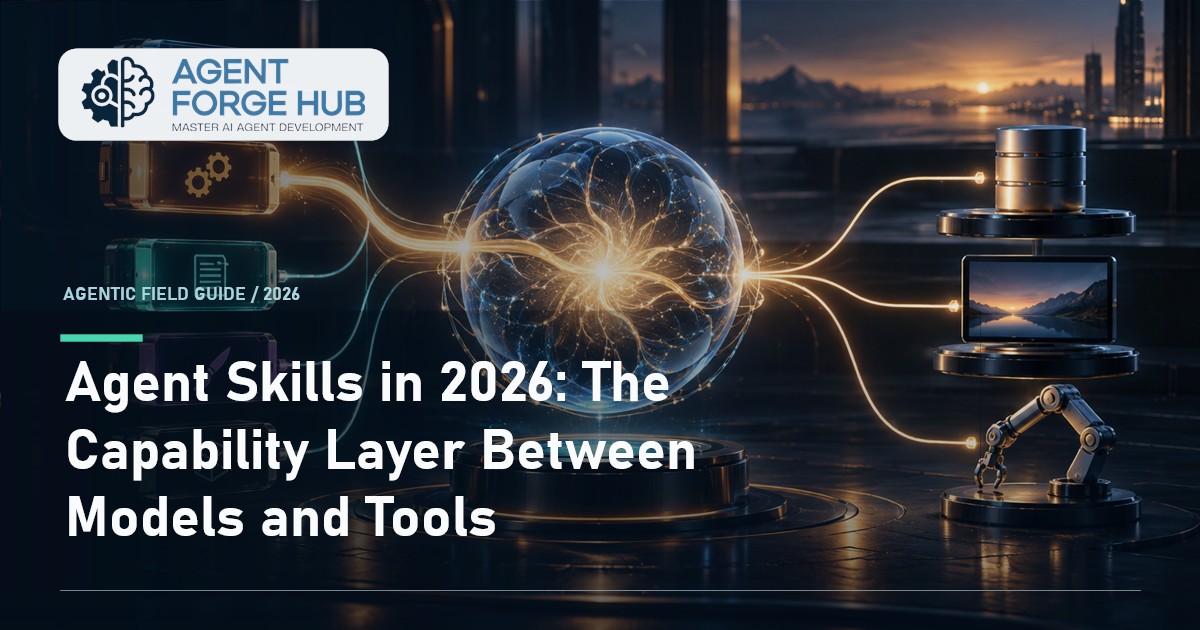
Agent Skills in 2026: The Capability Layer Between Models and Tools
For years, teams customized AI with one increasingly long prompt.
The prompt began as a few sensible instructions. Then it acquired the brand voice, the deployment checklist, the contract-review policy, twelve examples, three exceptions, and a paragraph written after an incident nobody wanted to repeat. Eventually, every task arrived carrying a company handbook in its backpack.
Agent skills offer a cleaner idea: package the instructions and resources for a repeatable job, then load them only when that job appears.
The distinction sounds small. It is not. Skills turn agent behavior from prompt folklore into something closer to maintainable software.
TL;DR
An agent skill is a reusable capability package: focused instructions, supporting references, scripts, templates, and rules for a particular workflow. Tools expose actions; skills explain how to combine those actions well. Strong skills are narrow, discoverable, testable, versioned, and treated as part of the software supply chain.
Tools provide verbs; skills provide operating knowledge
Imagine an agent connected to a CRM. Its tools may include:
find_accountlist_opportunitiesupdate_forecastcreate_follow_up
Those verbs do not teach the agent how your sales team runs a quarterly forecast. They do not explain which opportunity stages count, how stale activity changes confidence, when a manager must approve an override, or what the final briefing should look like.
That missing layer is the skill.
A forecast skill could contain:
- workflow instructions
- field definitions and stage rules
- a script that checks totals
- an output template
- examples of valid exceptions
- escalation criteria
This is why skills and MCP servers are complements, not competitors. An MCP server can expose live data and controlled actions. A skill can teach the agent how to use those capabilities for a recognizable business outcome.
OpenAI's current Skills documentation describes skills as directories containing reusable instructions and supporting files, discovered through lightweight metadata and opened when relevant. That progressive loading pattern is the important architectural move: the agent knows what capabilities exist without stuffing every capability's full manual into every request.
Progressive disclosure beats the mega-prompt
Skills reduce context clutter through three layers:
- Discovery metadata tells the agent a skill exists and when it applies.
- Core instructions explain the workflow once selected.
- Supporting resources are opened only when a specific step needs them.
That structure keeps the active context focused. A contract-review task does not need release-engineering procedures. A deployment task does not need the editorial style guide. Both remain available, but neither taxes every run.
This improves more than cost. Irrelevant instructions can conflict with relevant ones. A smaller, task-specific instruction set is easier for the model to follow and easier for humans to inspect.
For the broader context principle, see Context Engineering for AI Agents.
What belongs in a skill
A useful skill should answer five questions:
1. When should I use this?
The description is routing logic. Write it in the language users actually use, including likely trigger phrases and clear exclusions.
"Helps with finance" is weak. "Reconciles monthly SaaS revenue between Stripe exports and the general ledger; use for close preparation, discrepancy analysis, and reconciliation reports" is much better.
2. What outcome am I producing?
Define a concrete artifact or state change: a reviewed pull request, a reconciled spreadsheet, a launch brief, a support escalation, or a validated deployment.
Without an outcome, a skill becomes a collection of advice rather than an executable workflow.
3. What sequence is reliable?
Specify the load-bearing order of operations. Include decision points, validation steps, and stop conditions. Leave room for judgment where the model can genuinely help; lock down the steps where improvisation creates risk.
4. What resources should I reuse?
Bundle templates, schemas, examples, and scripts that prevent reinvention. A deterministic script is usually better than asking the model to recalculate the same thing creatively on every run.
5. When must I stop or escalate?
Skills should describe refusal and handoff behavior. Missing evidence, conflicting records, sensitive data, failed tests, or actions above a risk threshold should have explicit paths.
A skill is not a personality
One common mistake is creating skills around roles: "Be a senior marketer," "Act like a lawyer," or "Think like a product manager."
Roles can shape perspective, but they are poor capability boundaries. They are broad, hard to test, and likely to overlap.
Prefer jobs with observable results:
| Weak boundary | Better skill boundary |
|---|---|
| Senior engineer | Diagnose a failing CI run |
| Marketing expert | Produce a launch messaging brief |
| Legal assistant | Compare a vendor agreement against the fallback-clause library |
| Data analyst | Validate and explain weekly funnel changes |
The better boundaries make it possible to write fixtures, define pass conditions, and assign ownership.
Treat skills like software
Once a skill influences real work, it deserves engineering discipline.
Version it. Review changes. Record an owner. Test it against representative tasks. Track which version produced each important artifact. Retire obsolete versions instead of leaving several nearly identical choices in discovery metadata.
A minimal evaluation set should cover:
- correct selection when the skill applies
- correct rejection when it does not
- successful happy-path execution
- handling of missing or contradictory inputs
- safe behavior at escalation boundaries
- output conformance to the promised format
Selection deserves its own tests. A beautifully written skill that is never chosen is useless; an overbroad skill that hijacks unrelated tasks is worse.
The security boundary matters
Skills are instructions the agent may trust, and some include executable scripts. That makes them part of your supply chain.
Before installing a third-party skill, review:
- all instruction files, not only the manifest
- bundled scripts and dependencies
- network destinations
- tools and credentials it expects
- files it can read or modify
- instructions that attempt to suppress approvals or logging
Use least privilege at runtime. A reporting skill should not inherit production-write credentials merely because another skill needs them. Pin reviewed versions for sensitive workflows and preserve a provenance trail for updates.
The same mindset applies to tool servers, which is why Agent Identity and Credential Brokers pairs naturally with a skill architecture.
Build a capability portfolio, not a skill landfill
As teams adopt skills, duplication arrives quickly. Finance creates a CSV validator. Operations creates another. Sales creates a third with slightly different rules and the most enthusiastic filename.
Manage the portfolio deliberately:
- maintain a searchable catalog
- assign domain owners
- separate shared primitives from business workflows
- measure usage and success by skill version
- merge overlapping skills
- archive skills whose underlying process no longer exists
Do not measure success by the number of skills installed. Measure whether common work becomes more reliable, faster, and easier to delegate.
A practical first skill
Choose a workflow that is repeated, bounded, and annoying. Good first candidates include release notes, support-ticket triage, weekly KPI commentary, dependency updates, or document quality checks.
Then:
- Write the trigger and non-trigger conditions.
- Define the expected artifact.
- Capture the current human workflow.
- Convert deterministic steps into scripts or templates.
- Add failure and escalation rules.
- Test on ten real examples and several adversarial ones.
- Review the skill after the model or toolchain changes.
This last step matters. OpenAI's guidance on rethinking skills as models improve makes a useful point: scaffolding can become stale. A skill should encode durable process knowledge, not preserve every workaround a weaker model once required.
Summary
The agent stack now has a useful middle layer.
Models provide general intelligence. Tools provide access. Skills provide the practical knowledge that turns access into competent work.
The winners will not be the teams with the largest prompt or the most skills. They will be the teams that turn their best repeatable workflows into focused, reviewed, measurable capability packages, then keep those packages as carefully as they keep code.
Related Tools
Useful tools for this topic
If you want to turn this article into a concrete next step, start with one of these.
Solution Type Quiz
PlanningDecide whether your use case is better served by automation, a chatbot, RAG, a copilot, or a more capable agent.
Open toolReadiness Scorecard
PlanningAssess whether the workflow, data, access, and risk controls are mature enough for a real pilot.
Open toolPattern Selector
ArchitectureChoose between patterns like RAG assistant, workflow agent, approval-gated agent, or multi-agent setup.
Open toolSubscribe to AgentForge Hub
Get weekly insights, tutorials, and the latest AI agent developments delivered to your inbox.
No spam, ever. Unsubscribe at any time.